Northern Lights Season Guide: When and How to See the Aurora in Iceland
From Reykjavik: Northern Lights Tour with Lifetime Guarantee
When is the best time to see northern lights in Iceland?
The aurora is visible from mid-September to early April, requiring dark nights. Peak months are November through January (longest darkness). Clear skies matter more than the exact date -- Iceland's weather is the main limiting factor.
Why darkness matters more than solar activity
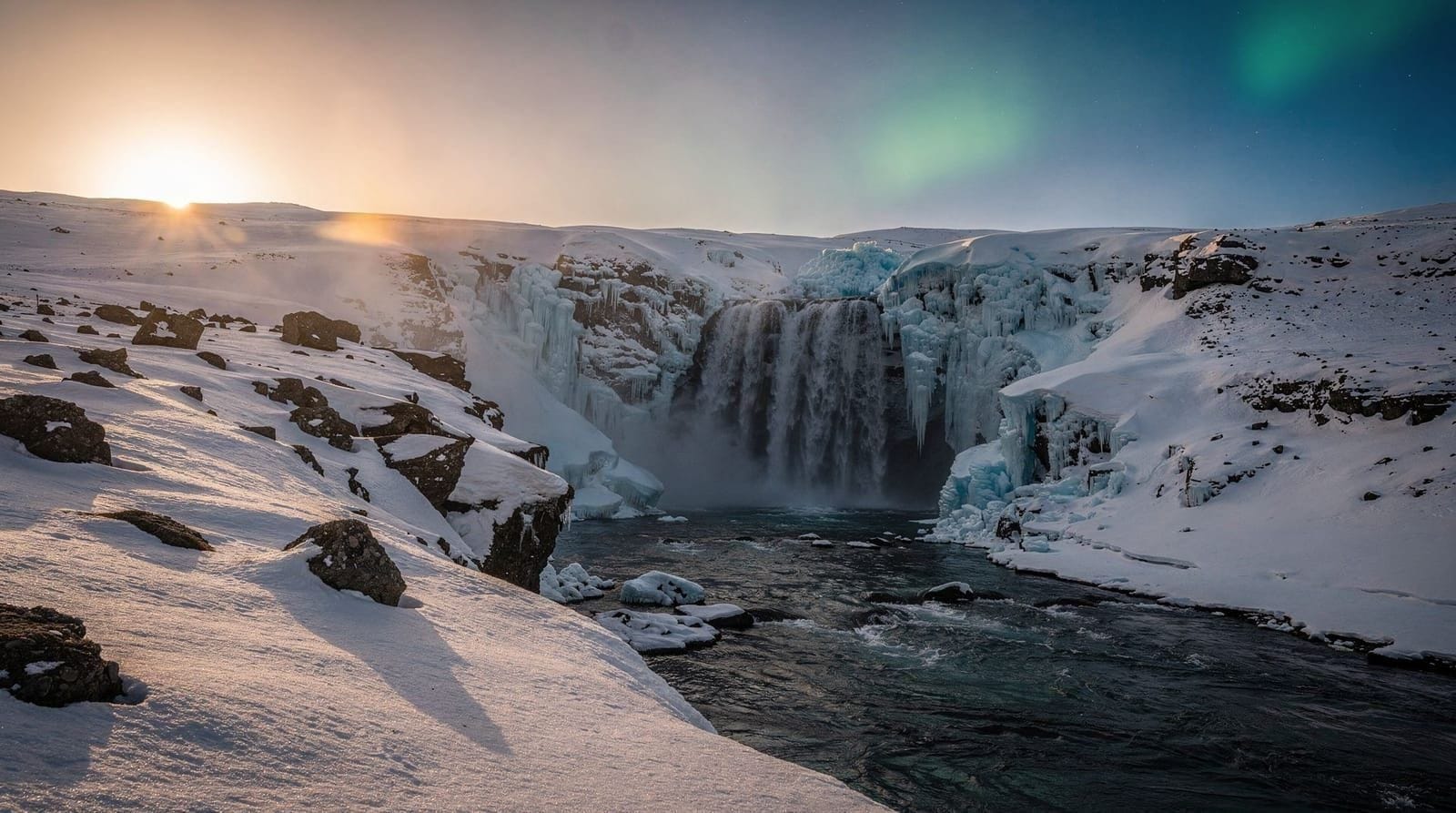
The northern lights are caused by charged particles from the sun interacting with gases in the Earth’s upper atmosphere. This process is ongoing around the clock and peaks with increased solar activity. The reason we can only see the aurora at certain times in Iceland is purely about light: you need a dark sky to see the faint glow.
| Season | Mid-September to early April |
| Peak months | November-January (longest darkness) |
| What you need | Dark sky + clear weather + some solar activity (Kp 2+) |
| Best odds | 4-5 nights in Iceland, away from city lights |
| Cost | Free if self-driving; guided tours from around ISK 15,000-20,000 |
Iceland sits between 63 and 66 degrees north. Above the Arctic Circle (66.5 degrees north), the midnight sun persists for weeks around midsummer. Even in Reykjavik at 64 degrees, civil twilight barely ends from late May to late July. The aurora may be active during those months, but the sky is simply too bright to see it.
The aurora season effectively runs from mid-September (when true darkness returns) to early April (before daylight extends past midnight again). This gives you roughly six and a half months — a long window, but entirely dependent on the second variable: cloud cover.
The cloud cover problem
Iceland’s weather is driven by North Atlantic low-pressure systems moving rapidly from west to east. Cloud cover over Reykjavik can change completely within hours. A perfectly clear forecast at 18:00 can turn to overcast by 21:00 — and vice versa.
This is why the strategy of multiple nights in Iceland is so important. With three nights, you have a reasonable statistical chance of at least one clear, active night. With one night, you are at the mercy of luck regardless of what the forecasts say.
The practical approach: check the 3-day cloud cover forecast on Vedur.is when you arrive. If night 2 looks clearest, do not go hunting on night 1. If all three nights look overcast, a tour operator with the ability to drive several hundred kilometres can still find gaps. The weather is often dramatically different between the Reykjavik area (which sits in a wet Atlantic wind corridor) and the eastern interior.
Aurora forecasting: what to actually check
Vedur.is cloud cover forecast: the most important tool. Select the cloud cover layer on the map. Zoom to Iceland and look for gaps in coverage between 21:00 and 02:00 local time. This is your first filter.
Kp index forecast: the Kp index (planetary index) rates geomagnetic activity on a scale from 0 to 9. At Iceland’s latitude, Kp 2-3 is sufficient for visible aurora under dark skies. Kp 4-5 produces reliable, structured displays. Kp 7+ creates dramatic curtains and colours visible over most of Iceland, sometimes even with moderate cloud.
The NOAA 3-day Kp forecast gives useful guidance, though aurora prediction beyond 2 days is imprecise. For real-time activity, the Bz component of the solar wind (southward = good for aurora) is the most reliable short-term signal.
Aurora apps: Space Weather Live, My Aurora Forecast, and Aurora Notifier are all used by visitors and locals. Set notifications for Kp above 3 and pair them with the cloud forecast. Getting a Kp alert is meaningless if you cannot see through the clouds.
Month-by-month at a glance
| Month | Darkness | Temp (Reykjavik) | Notes |
|---|---|---|---|
| September | 4-6hrs by late month | 5-10°C | Season begins, moderate prices |
| October | Reliable from ~20:00 | 3-8°C | Popular first-timer month |
| November | Growing fast | 0-5°C | Chasers arrive, book ahead |
| December-January | Up to ~18hrs | Below 0°C | Peak darkness, peak prices |
| February | Similar to Dec-Jan | Below 0-2°C | Often more stable weather |
| March | Shortening, equinox boost | 2-5°C | Slightly elevated solar activity |
| April | Last reliable month | 2-6°C | Fading fast after mid-month |
Month-by-month breakdown
September: first dark nights of the season. Autumn colours on Icelandic vegetation, moderate temperatures (5-10°C), and the aurora season beginning. A genuinely good month: not as cold as December-February, and the novelty of the season means prices are slightly lower. Expect 4-6 hours of true darkness by late September.
October: reliable darkness from 20:00, temperatures around 3-8°C. A popular month for first-time visitors who want aurora without extreme winter. The South Coast and Golden Circle are still very accessible.
November: significant drop in light pollution as daylight shortens sharply. Temperatures drop to 0-5°C. Weather becomes more volatile. This is when serious aurora chasers start arriving in numbers. Book accommodation and tours further in advance.
December-January: maximum darkness. Sunrise around 11:30, sunset around 15:30 in late December. This means up to 18 hours of potential darkness — though hours of actual clear sky are another matter. Temperatures frequently below 0°C, occasional ice on roads. The peak “bucket list” aurora months, hence peak prices for flights and accommodation.
February: similar darkness to December-January but with noticeably lengthening days. Often slightly more stable weather than January. Snowfall can be heavy, making the landscape particularly photogenic under the aurora.
March: conditions start to moderate. Days lengthen quickly. March equinox produces higher solar activity statistically (a real effect — geomagnetic activity is slightly elevated around equinoxes). Temperatures rise toward 2-5°C.
April: last reliable aurora month. By late April, twilight at midnight makes seeing faint aurora difficult. The midnight sun guide covers what happens as summer approaches.
Best locations for northern lights viewing
Distance from Reykjavik: any location 20-30 km from the city significantly reduces light pollution. Common destinations are the Blafjoll mountain area (southeast), the Grindavik road (southwest), and the road toward Mosfellsbaer and Thingvellir (northeast).
Thingvellir National Park: 45 minutes from Reykjavik, sitting in a rift valley with minimal light pollution. The Golden Circle route passes through it, and some visitors who have rented a car combine a daytime Golden Circle drive with an evening aurora stop at Thingvellir.
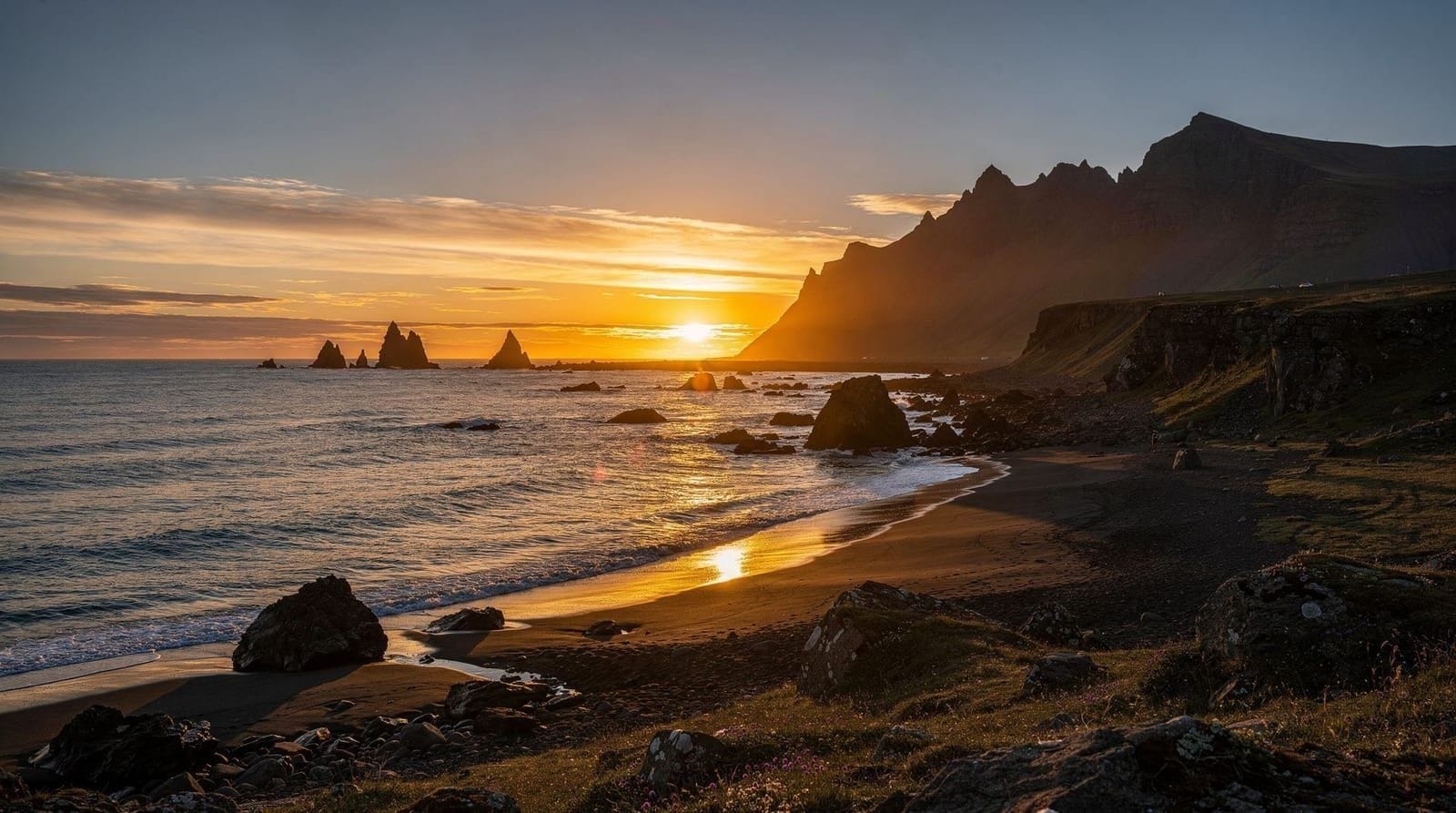
South Coast: the stretch of Route 1 between Hvolsvollur and Vik has very little ambient light. The black sand beaches at Vik offer dramatic foreground subjects for aurora photography. Staying overnight in Vik rather than returning to Reykjavik puts you in a better position for evening viewing.
Snaefellsnes Peninsula: further from Reykjavik but offers Snaefellsjokull glacier as a foreground. The Snaefellsnes peninsula is worth the drive on a clear night and makes excellent sense if combined with a daytime exploration.
Choosing a tour vs. going independently
Tours add value in specific ways: guides track forecasts professionally and have experience reading which cloud breaks will persist, transport is provided so you are not driving unfamiliar icy roads at night, and retry policies provide insurance against bad luck.
The lifetime guarantee northern lights tour is worth considering if you visit Iceland more than once — the retry is valid on any future trip, not just the current one.
A super jeep northern lights hunt provides the best cloud-chasing capability, reaching locations coaches cannot follow.
For independent travellers with a rental car, the cost is essentially fuel. The getting around Iceland guide has detail on winter driving conditions and what vehicle type makes sense.
Setting up aurora alerts
If you are staying in Reykjavik for several nights, set up a system rather than manually checking every hour:
- Install Space Weather Live or My Aurora Forecast and set a Kp alert at 3 or above for your location
- Check Vedur.is cloud forecast at 18:00 and 20:00 each evening
- If both conditions align, go out immediately — conditions can deteriorate within an hour
The Vedur.is website has an English version and is the authoritative source used by local guides. Do not rely solely on aurora apps for cloud cover — their cloud forecasting is less detailed than the Met Office data.
Managing expectations honestly
On a 5-night winter trip, the statistical likelihood of seeing at least one aurora display is high — perhaps 70-80% based on historical clear-sky frequency and average solar activity. On a 2-night trip, it drops to 40-50%. On a single night, you are mostly at the mercy of fortune.
The displays you see on social media are the exceptional ones: Kp 7+ events photographed with high-ISO cameras on long exposures in perfect conditions. A typical aurora sighting is more subtle: a faint greenish arc across the northern horizon that brightens and fades over 20-30 minutes. It is still worth seeing. Manage expectations and appreciate what you see.
For more context on planning the right season for your trip, see the best time to visit Iceland guide and the Iceland winter vs summer comparison.
The solar cycle and long-term aurora patterns
Solar activity follows an approximately 11-year cycle between solar minimum (low activity) and solar maximum (peak activity). During solar maximum, coronal mass ejections and solar wind gusts are more frequent, producing higher average Kp values and more predictable displays.
The current solar cycle (Solar Cycle 25) reached solar maximum around 2024-2025 and is now descending toward a minimum expected around 2030. This means the 2026 aurora season, while still active, is past the period of most intense solar activity. The aurora is still absolutely visible and worth chasing — even at solar minimum the Kp 2-4 range produces regular displays in Iceland.
The practical implication: between now and 2028, gradually decreasing solar activity will produce fewer dramatic Kp 7+ events, but reliable Kp 2-4 events will continue throughout every aurora season.
Aurora colours: what to expect
The aurora appears in different colours depending on altitude and atmospheric composition:
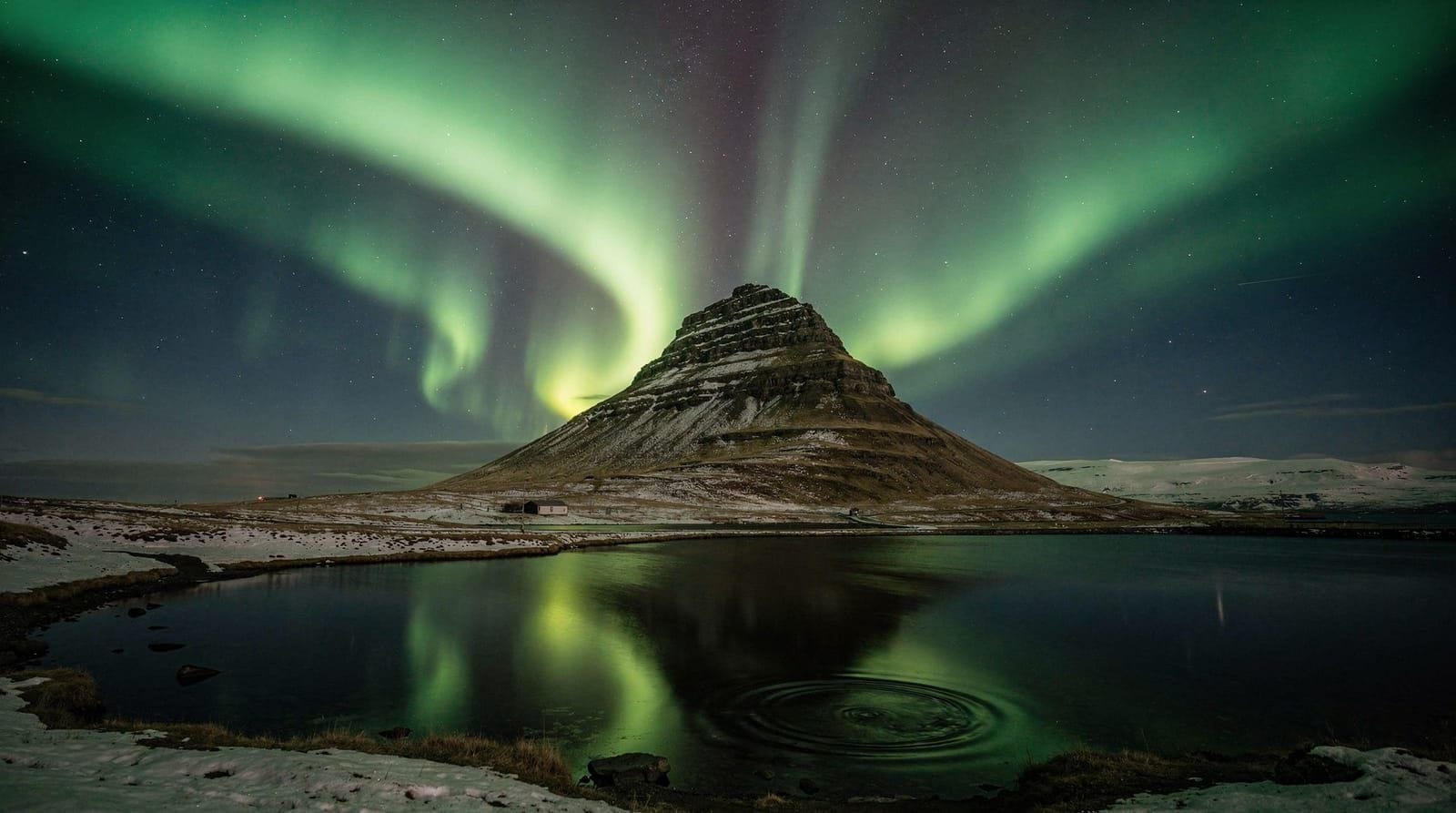
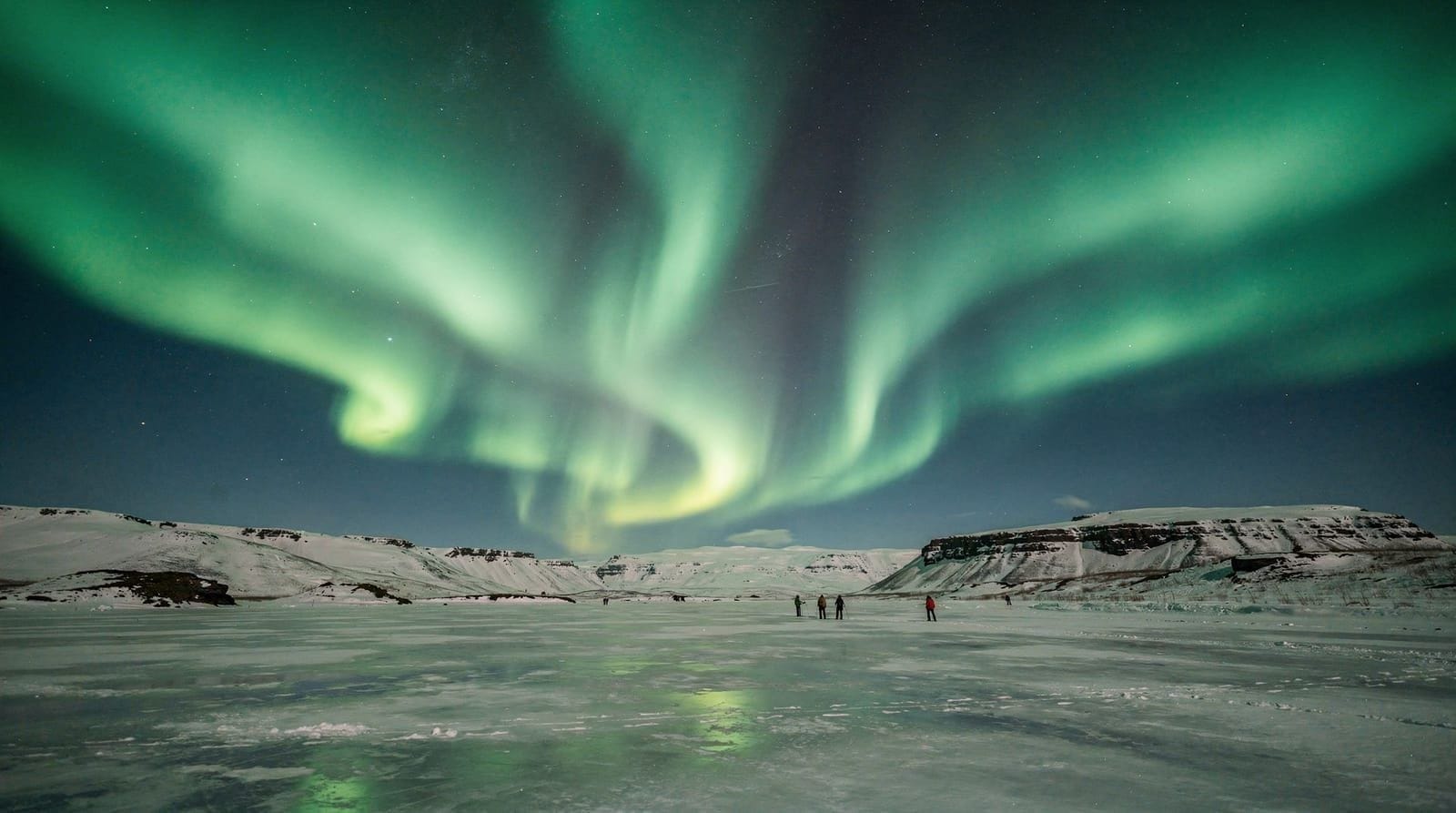
Green: the most common colour. Caused by oxygen atoms at altitudes of 100-300 km reacting with solar particles. Green is what most aurora displays produce and what the eye sees most readily at low light levels.
Pink/red fringe: sometimes visible at the base or edges of a display. Caused by nitrogen molecules at lower altitudes. Usually requires a fairly strong Kp to see.
Purple/violet: nitrogen emissions at higher altitudes. Occasionally visible in strong displays, often photographed more vividly than seen by eye.
Red: rare but dramatic. Occurs at very high altitudes (above 200 km) during strong geomagnetic events. More easily photographed than seen by eye.
Cameras on long exposure often capture colours more vividly than the naked eye. This is expected — cameras integrate light over 10-20 seconds while the eye sees instantaneously. An aurora that looks faint white-green to the eye may appear vivid green in a 20-second exposure. Do not be disappointed if the real-life view looks less dramatic than social media images — the experience is still remarkable.
Camera settings for aurora photography
A basic setup works for most visitors: a camera capable of manual mode (mirrorless, DSLR, or a modern smartphone’s night mode), a tripod, and a remote shutter or timer to avoid camera shake. Start around ISO 1600-3200, an aperture as wide as your lens allows (f/2.8 or wider is ideal, f/4 workable), and a shutter speed of 8-15 seconds — faster if the aurora is moving quickly to preserve detail in the curtains, slower for faint, static glows.
Focus manually to infinity in the dark; autofocus usually fails on a night sky. Modern smartphones with dedicated night modes can capture a surprisingly usable aurora shot handheld on a wall or railing, though a small tripod still helps. Bring spare batteries — cold weather drains them fast, and dead batteries are the single most common reason photographers miss a display mid-show.
Combining aurora hunting with a Reykjavik-based trip
For visitors based in Reykjavik without a rental car, the practical pattern is to spend daylight hours on city sights or a Golden Circle day trip, then check the forecast each evening and head out only if conditions align. This avoids the fatigue of every-night hunting and concentrates effort on the nights with the best odds. A combined evening out, such as this Secret Lagoon, dinner, and northern lights hunt package, is a natural way to fill a hunting evening even if the aurora does not show. The Iceland winter 4-day itinerary builds this flexible evening slot into a broader winter schedule, treating aurora hunting as a bonus activity layered onto daytime sightseeing rather than the sole focus of the trip.
Frequently asked questions about northern lights season in Iceland
What Kp index do you need to see northern lights in Iceland?
Iceland sits at roughly 65 degrees north latitude. A Kp of 2-3 is sufficient for visible northern lights under dark, clear skies in Iceland. Higher Kp (5+) produces dramatic displays visible even from the city. Most memorable aurora events in Iceland occur at Kp 3-5.
Can you see the northern lights from Reykjavik itself?
During strong aurora events (Kp 4+), the lights are visible from Reykjavik despite the city’s light pollution. Grottan lighthouse at the western tip of the Seltjarnarnes peninsula is the best in-city viewpoint. For reliable viewing, drive 20-30 km out.
How do you forecast northern lights in Iceland?
Use Vedur.is (Icelandic Met Office) for cloud cover forecasts — this is the critical variable. For solar activity, check NOAA Space Weather Prediction Center or apps like Space Weather Live. A clear sky on a moderate Kp night beats a high-Kp cloudy night every time.
Is the midnight sun a problem for northern lights viewing?
Yes. From late May to late July, Iceland has essentially continuous daylight, making aurora viewing impossible regardless of solar activity. The sky is not dark enough. The transition months of August and early September have limited darkness but can occasionally show faint aurora on very clear nights.
Can you see northern lights in October?
Yes, October is a reliable aurora month. Nights are dark by 20:00 and temperatures are mild by Icelandic standards. Many visitors find October an excellent compromise: aurora season, fewer crowds than January, and driving conditions less severe than mid-winter.
What should you do if you miss the northern lights?
Stay flexible, extend your trip if possible, and consider a tour with a retry guarantee. The aurora is probabilistic — multiple nights dramatically improve your chances. Accommodation near Thingvellir or on the South Coast puts you under darker skies than central Reykjavik.
Top experiences
Bookable activities with verified prices and instant confirmation on GetYourGuide.