Silfra Snorkeling and Diving in Iceland: Everything You Need to Know
Silfra: Snorkeling Tour Between Tectonic Plates
How cold is the water at Silfra?
Silfra water stays between 2 and 4 degrees Celsius year-round. You will be in a drysuit, not a wetsuit — drysuits keep you dry with minimal water contact. Most people find the cold manageable once in the water.
What makes Silfra extraordinary
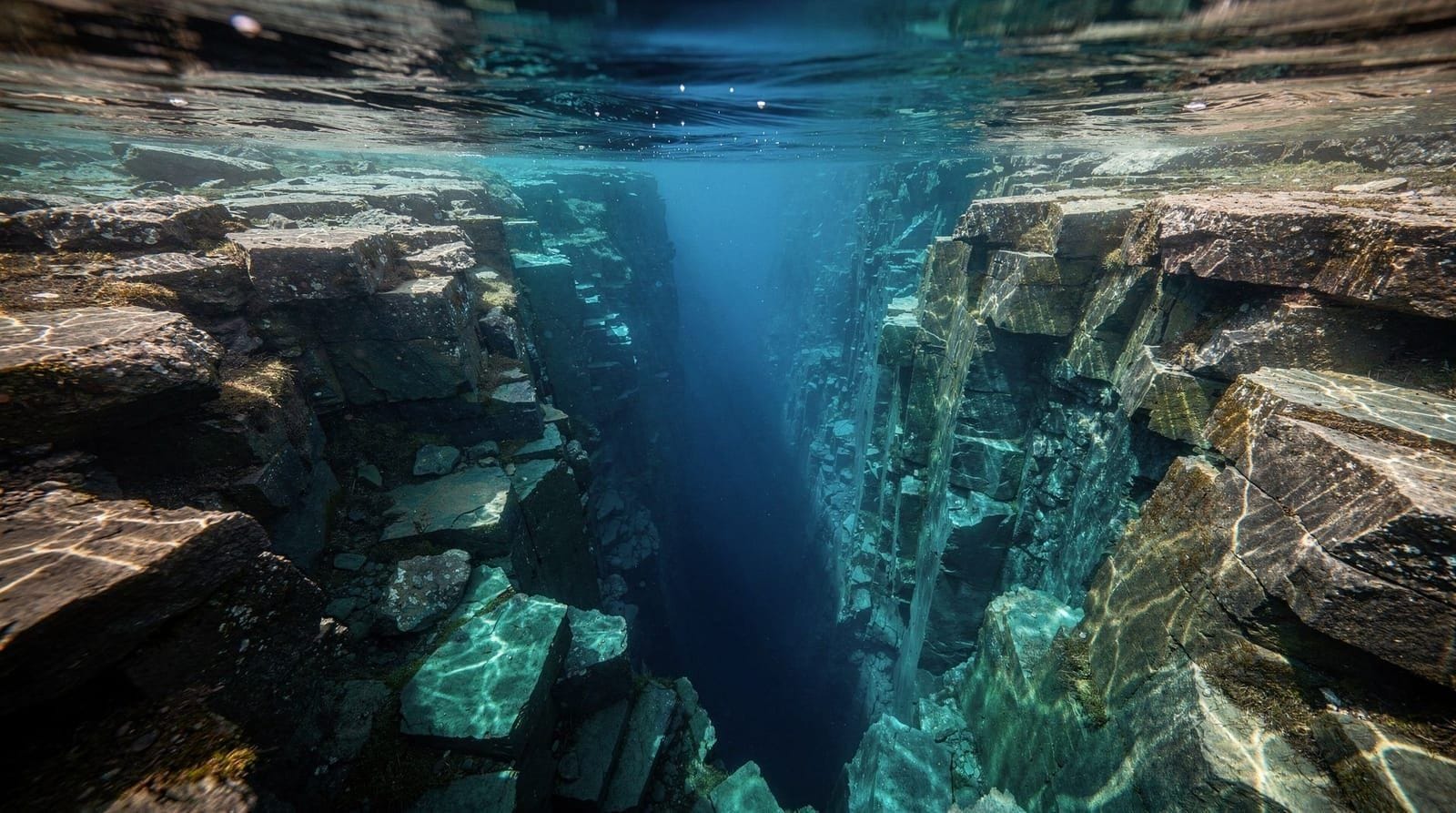
Silfra is a fissure in Þingvellir National Park where the North American and Eurasian tectonic plates meet. The crack between the plates has been slowly widening for millions of years, and at Silfra the gap is filled with glacial meltwater so pure that visibility reaches up to 100 metres — some of the clearest water on earth. You can drink it while you swim.
You are, in a literal sense, swimming in a crack between two continents. You can touch both tectonic plates simultaneously, placing one hand on North America and the other on Europe. This is not a marketing slogan; it is geologically accurate and visually obvious in the fissure walls.
The water is 2-4 degrees Celsius year-round. This is not the South Pacific. You will be cold on your hands and face — those are the only exposed skin in a drysuit. Most people report that after the first 5 minutes of adjusting, the cold becomes manageable and recedes from awareness as the underwater landscape takes over.
| Where | Silfra fissure, Þingvellir National Park, 45 min from Reykjavik |
| Cost | Around 18,000-25,000 ISK snorkeling; more for diving or photo packages |
| Time needed | Half a day including pickup, briefing, drysuit fitting and the swim itself |
| Getting there | Pickup from central Reykjavik hotels with most operators, or self-drive via Route 36 |
| Best time | Year-round — water temperature barely changes; book weeks ahead in June-August |
The drysuit: what you actually wear
Unlike wetsuits, which let water in and rely on body heat to warm that water, drysuits seal you completely inside a waterproof shell. You wear thermal undergarments underneath — provided by most operators — and the drysuit is sealed at the neck and wrists. Only your face is exposed via the mask.
The result is that your body stays dry. Hands and face will be cold. Drysuits also provide significant buoyancy, which means you float very naturally without effort. This is one reason the swimming requirement is lower than for many marine activities — you cannot sink in a properly fitted drysuit.
The fitting process takes about 15 minutes. The seals around your neck and wrists need to be tight. Guides check every seal. This is not a casual process because a failed seal means the suit floods.
Some people experience claustrophobia with the suit. If you have concerns, mention it when booking. The suit does not cover your face and the experience of floating at the surface is generally very free.
Silfra: Snorkeling Tour Between Tectonic PlatesThe swim: what you actually see
The Silfra snorkeling route runs from the entry point at Silfra Hall through Silfra Cathedral and Silfra Lagoon to an exit point roughly 300-500 metres away. The current is very gentle — most of the swimming is passive floating, with light kicks to steer.
Silfra Hall is the entry section, wide and shallow, where the fissure walls are clearly visible on both sides. The visibility here is often best.
Silfra Cathedral is the deepest and most dramatic section. The fissure walls are blue-grey and the depth can reach 63 metres directly below you (though you stay on the surface). Looking straight down is vertiginous and spectacular in equal measure. The blue-green light filtering through is extraordinary.
Silfra Lagoon is the exit section, wider and shallower. The teal-blue colour here is what appears in most of the photographs you have seen. Green algae called troll hair grows on the rocks in long strands that look otherworldly.
The water clarity means you can see detail 80-100 metres away. It is unlike any other snorkeling or diving location in the world.
Practical requirements and who cannot do this
You must be able to swim. This is the hard requirement. If you cannot swim unaided in open water, you cannot complete the tour safely. Operators will ask about swimming ability during booking and at the site.
Minimum age is typically 12 years. Children must fit the smallest available drysuit size and be comfortable in cold water.
Pregnancy: Pregnant women cannot snorkel at Silfra. This is a firm restriction from all operators.
Weight limit: Most operators have a maximum weight of approximately 115-120 kg for drysuit fit reasons. Check with your specific operator if this is relevant.
Medical conditions: Heart conditions, severe asthma, and claustrophobia are worth discussing with your doctor and operator before booking. The cold water stress is real.
Certification for diving: Scuba diving at Silfra requires a minimum PADI Open Water or equivalent, plus drysuit or cold water experience. This requirement is non-negotiable due to safety.
Booking and logistics
Silfra sits in Þingvellir National Park, 45 minutes from Reykjavik via Route 36. Most operators offer a pickup service from central Reykjavik hotels; confirm when booking.
Tour prices range from approximately 18,000-25,000 ISK per person for snorkeling, higher for diving. Underwater photography packages typically add 5,000-8,000 ISK. Photos are worth considering — the light quality and visibility make for extraordinary results. For budget context, see the Iceland cost and budget guide.
Book ahead. In summer (June-August) Silfra tours sell out weeks in advance. The site has a daily visitor limit because Þingvellir National Park manages access to protect the water quality. Þingvellir is also the Golden Circle’s first major stop, making same-day combinations efficient.
Cancellation policies vary by operator, but Silfra tours run in almost all weather since visibility is underwater and unaffected by wind or rain at the surface — the main reason for cancellation is high winds strong enough to affect safety on the surface between dives, which is uncommon. Check your specific operator’s policy when booking, and confirm the meeting point in central Reykjavik the night before if you are relying on the included pickup.
Silfra: Fissure Snorkeling Tour with Underwater PhotosCombining Silfra with the Golden Circle
Silfra is inside Þingvellir National Park, which is the first stop on the Golden Circle route. This makes the combination natural: snorkel at Silfra in the morning, visit Geysir and Gullfoss in the afternoon. The day is long (arrive by 8 a.m., back in Reykjavik by 8-9 p.m.) but very full.
Several operators offer this combination as a single booking. The Reykjavik 3-day itinerary places Silfra and the Golden Circle on the same day.
Golden Circle and Silfra Snorkeling Combo TourDiving at Silfra: what is different
Diving goes deeper into the fissure and allows a different perspective on the tectonic plates — you can see the walls descending to depth, and the blue-green colour of the deep water is different from the surface.
The logistics are more involved: briefing time is longer, gear is heavier, and you must demonstrate buoyancy control before entering. The experience is rated as a moderately challenging dive due to cold and visibility management.
Most divers who have done Silfra rate it among the top three dives of their lives. The visibility is unmatched. The setting — being inside a tectonic rift — is unrepeatable anywhere else on earth. If you are a certified diver, do not snorkel here. Do the dive — the Þingvellir Silfra fissure diving tour with optional pickup handles transport from Reykjavik if you would rather not self-drive.
Silfra: Diving Between Tectonic PlatesSilfra in the context of the Golden Circle
Þingvellir National Park — where Silfra is located — is also the first stop on the Golden Circle route. The park’s geological significance extends beyond the fissure: you can walk the Almannagjá rift gorge, visit the original site of Iceland’s Viking parliament (Alþing), and see the Öxará river running through the park.
Adding Silfra snorkeling to a Golden Circle day requires leaving Reykjavik by 7-8 a.m. The snorkel takes 3 hours including prep. Geysir and Gullfoss can be done in the afternoon. You return to Reykjavik around 8-9 p.m. It is a genuinely full day, but both experiences are at their best — Þingvellir before the buses arrive, Geysir in afternoon light.
If you prefer two separate days, putting Silfra on the Reykjavik weekend 2-day itinerary as a morning on day 1 (before the Golden Circle afternoon) or as a standalone morning activity works well. The Reykjavik 3-day itinerary includes Silfra as a morning before the Golden Circle.
The science of why Silfra water is so clear
The clarity of Silfra water is not coincidental. The lagoon sits on a fissure fed by groundwater that has filtered through volcanic rock for 30-100 years after falling as precipitation on Langjökull glacier. The lava rock acts as an exceptionally fine natural filter, removing almost all particulate matter. The result is water classified among the clearest on earth — visibility measured in excess of 100 metres.
The constant temperature (2-4 degrees year-round) also suppresses biological activity. Cold water holds more oxygen but fewer microorganisms than warmer water. The combination of mechanical filtration and biological suppression produces water that, were it not so cold, you could drink directly from the fissure. Several tour guides demonstrate this by doing exactly that. For packing advice specific to cold water activities, the Iceland packing guide covers drysuit-compatible clothing in detail.
This clarity is also why Silfra is so carefully protected. Þingvellir National Park enforces strict access controls, and tour operators must be licensed. The daily visitor limit is not arbitrary — human activity (even without touching) introduces turbidity. The fissure is in a better state now than in the 1990s when unregulated access was more common.
What no one tells you
Your hands will get cold in the first 3-5 minutes. After that most people’s hands go somewhat numb and the cold becomes less intrusive. Five-finger neoprene gloves are sometimes provided; ask your operator in advance.
The drysuit changes your buoyancy — you float very high in the water, which means pushing your face underwater to look down requires more effort than in a pool. This is normal and you adjust in a few minutes.
Condensation inside the mask happens frequently. Guides show you how to clear it. This is a universal issue and not a sign of a problem with your mask.
The underwater photos look better than the above-water ones. The light through the fissure, the troll hair algae, and the visibility combine to make extraordinary images. If you have any interest in the photos, get them — they are impossible to replicate yourself.
Silfra is often described as “peaceful” rather than thrilling. It is not an adrenaline experience. It is one of the most visually strange and serene things you can do on earth.
Snorkeling vs diving vs photo package: which to choose
| Option | Typical cost (ISK) | Who it suits |
|---|---|---|
| Snorkeling | ~18,000-25,000 | Anyone who can swim, no certification needed, best value |
| Snorkeling + underwater photos | ~23,000-33,000 | Anyone who wants proof — the images are hard to replicate yourself |
| Diving (certified divers only) | Higher, varies by operator | Certified divers wanting the deepest, most dramatic perspective |
| Golden Circle + Silfra combo | Priced per operator, usually a modest premium over snorkeling alone | Visitors who want to see Geysir and Gullfoss the same day |
For most first-time visitors, snorkeling with the photo package is the sweet spot: it needs no certification, and the photos capture what your own phone cannot underwater.
Frequently asked questions about Silfra snorkeling diving Iceland
How cold does it really feel?
The body inside the drysuit is comfortable. Face and hands feel cold initially. Within 5-10 minutes most people stop noticing the cold because the visual experience takes over. People describe it afterwards as “cold but completely worth it.”
Is Silfra safe?
Yes, with a guide. The fissure has no current that could trap you, the drysuit keeps you floating, and guides monitor every participant. The main risk is a poorly fitted drysuit, which guides check meticulously.
What do I do with my camera?
Most operators do not allow personal cameras in the water for insurance and safety reasons. Professional underwater photos are taken by the tour guide and sold as a package. The quality is typically excellent.
How far in advance should I book?
At least 2-4 weeks in summer. In shoulder season (April-May, September-October) 1-2 weeks is usually sufficient. Winter is quieter and same-week bookings are sometimes possible, but why risk it.
Can I do Silfra without any previous cold water experience?
Yes. The drysuit handles the cold. The main adjustment is the feeling of the tight neck seal and the high buoyancy. Neither requires previous experience.
Is the Golden Circle combination exhausting?
It is a long day. Silfra in the morning (leave at 7-8 a.m., done by 11-12) then the Golden Circle until 7-8 p.m. Rewarding but tiring. The Reykjavik weekend 2-day itinerary places Silfra on day 1 with the Golden Circle, which works well as a long first day.
What if I am a weak swimmer?
Weak swimmers often manage Silfra better than they expect because the drysuit buoyancy is so high. However, you need to be capable of swimming without a flotation device in case the suit is adjusted. If you genuinely cannot swim, this tour is not for you.
What should I wear under the drysuit?
Most operators provide thermal base layers and a fleece undersuit, so normal clothing underneath is not needed and can actually reduce insulation. Wool or synthetic socks help with cold feet, since feet along with hands and face are the areas most exposed to the cold. See the Iceland packing guide for what to bring for the rest of your cold-weather activities.
Can I do Silfra and the Golden Circle on the same day comfortably?
Yes, but it is a long day rather than a relaxed one — expect to leave Reykjavik by 7-8 a.m. and return by 8-9 p.m. If you would rather split it up, the Reykjavik 3-day itinerary and Reykjavik weekend 2-day itinerary both show how to sequence Silfra against the rest of the Golden Circle.
Top experiences
Bookable activities with verified prices and instant confirmation on GetYourGuide.